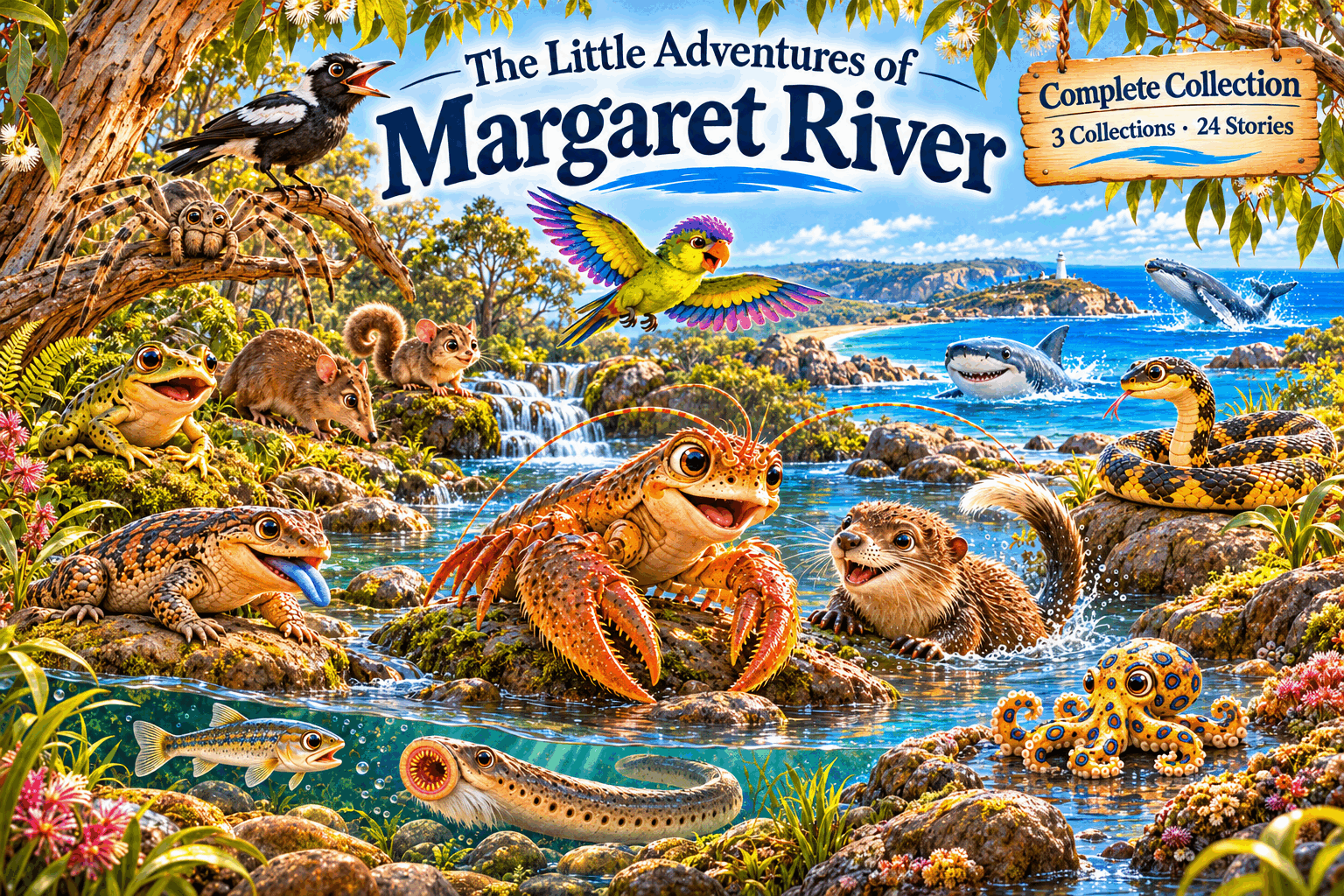
Three collections · One connected world
A Thoughtful Progression of Ideas
The twenty-four-book series is arranged into three collections, each developing a different aspect of how children relate to themselves, other people and the natural world. The progression is subtle rather than instructional. The first collection builds relationships and a sense of belonging; the second expands the characters' horizons and invites them to look differently; the third explores respect, boundaries and coexistence with wildlife. Taken together, they create a recognisable philosophy without requiring any individual story to carry the weight of the whole series.
Collection One
The River and Its Friends
Understanding ourselves and one another.
The first collection creates a small community among the stones, roots, shallows and riverbanks of Margaret River. Its stories are centred on qualities that matter in childhood: recognising one's own strengths, finding the confidence to speak, accepting help and appreciating what others bring to a friendship. Milly Marron discovers that the feature she once felt embarrassed about can become a strength when someone needs her. Borro Crayfish learns that a difficult problem is sometimes better solved together, while Pip Frog discovers the importance of being taken seriously even when the problem appears small to everyone else.
Other adventures encourage children to look beyond the obvious. Rikki Rakali's search for treasure becomes a discovery of what is already alive around him. Finn Minnow follows a familiar but changing waterway, and Old Lamprey's journey upstream gently challenges the notion that progress must always be fast or uninterrupted. When the river rises, Penny Possum and her friends draw on their different abilities to find safety. Coco Cowara's story then brings the wider group together, finding room for new beginnings without asking anyone to forget what came before.
The recurring characters are important. Someone who appears only briefly in one story may have a central role in another, allowing children to build familiarity with a community rather than merely follow a sequence of unrelated adventures. Friendship, empathy, cooperation and self-acceptance emerge through the actions of recognisable individuals, and the river itself feels increasingly like a shared home.
Collection Two
Beyond the River
Discovering the wider world and seeing it differently.
The second collection expands both the landscape and the possibilities for storytelling. Beyond the river are the forest canopy, coastal scrub, limestone caves and the wide waters bordering the region. Lulu Leeuwin moves slowly enough to notice signs along the way that her quicker friends overlook, turning a simple journey into a story about inclusion and the value of careful observation. Eddie Eagle can see great distances from above but needs help to understand what is hidden beneath the leaves, reminding children that even an extraordinary ability has its limits.
Cave Stalactite brings a different kind of perspective. Hanging quietly in a limestone cave, he wonders whether he can see himself growing, and learns that some changes take far longer than a moment, a day or even a lifetime to notice. Wanda Whale carries the adventures out to sea, where the contrasting personalities of a great humpback and a lively shearwater give a journey along the coast both humour and emotional warmth. When the weather turns, the story acknowledges that courage can include feeling afraid and staying close to someone we trust.
Across the collection, discovery is not presented as travelling farther for its own sake. It can also mean pausing, looking from another angle, noticing what has always been there, or recognising that another creature's experience of the same place may be entirely different. That is a valuable idea for children, and it is conveyed through tangible landscapes and events rather than abstract explanation.
Collection Three
Respecting Nature
Understanding wildlife, recognising boundaries and learning to coexist.
The third collection adds an important dimension to the series by exploring animals that are often feared, misunderstood or judged by their appearance. A blue-ringed octopus, huntsman spider, tiger snake, magpie, bobtail lizard and great white shark offer very different ways of thinking about wildlife. Some have powerful defences, some protect their young or territory, and others simply behave in ways people may find unfamiliar. Their place in nature is not defined by whether people find them cute, approachable or reassuring.
The message is neither that these creatures are villains nor that they are harmless friends waiting to be approached. Respect requires knowledge as well as kindness. A blue-ringed octopus must not be handled; a snake needs room to move away; a shark belongs in the ocean on its own terms. Children can be interested in an animal, appreciate its beauty and understand its role in the ecosystem without touching it or seeking a close encounter. In that sense, giving wildlife space becomes an act of care rather than fear.
This theme complements the earlier collections. Children who have explored friendship and learned to consider other perspectives are invited to extend that understanding beyond their familiar companions. Nature does not always behave according to human expectations, and responsible coexistence begins by recognising the boundaries of wild creatures. The stories encourage curiosity without carelessness, informed caution without hostility, and an appreciation of animals whose lives are very different from our own.